
Let’s start chez moi!
Our Home Fix It list includes:
The deck has a few boards sticking up. Main tool: hammer.
The showerhead needs replacing. Main tool: pliers.
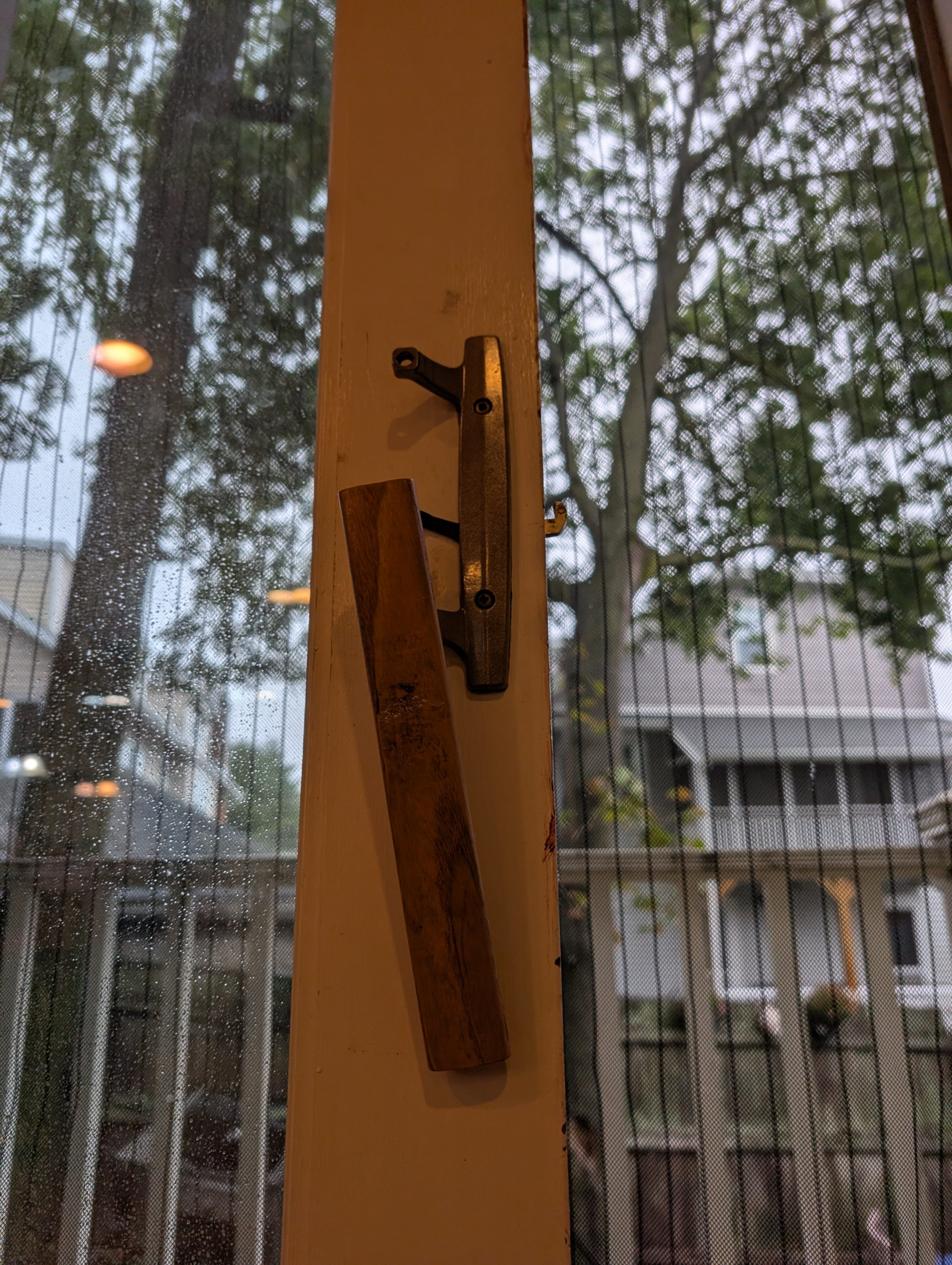
The patio door handle is broken. Main tool: screwdriver.
The tree needs trimming. Main tool: saw.

Which one first?
Honestly, all four have a reasonable case. The first job is to rule out anything dangerous. A branch can’t fall on little Grizzly (#4). The deck can’t collapse under Thanksgiving guests (#1).
Once we check for that, there’s no obvious winner.
Our teen nominates the showerhead. She wants more water pressure. She says she can’t feel “really clean.”
#3, the door handle, works! Sort of. It just looks ridiculous.
The doorbell has been broken a while. Maybe a feature? Deters the political door knockers?
Anyway, a normal household. Several reasonable problems. Once you rule out the urgent stuff, the order is a judgment call. You pick based on what bugs you most, what’s cheap, who in the family is lobbying hardest.
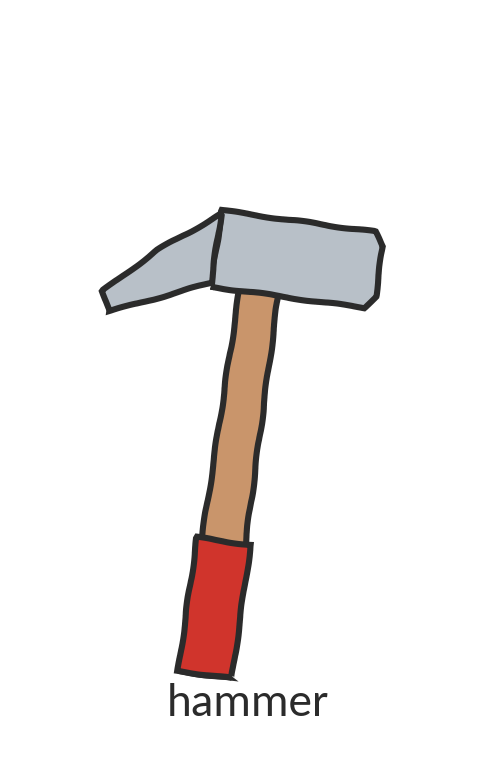
Now imagine I only had a hammer. I’ve labeled it below just so you’re clear.
The deck gets fixed. Great. Then I look at the showerhead. Hmm. The door handle. Hmm. The tree. I could probably whack a branch off. None of these is a hammer problem. But a hammer is what I’ve got.
Moreover, imagine a world where I only knew about hammers. It’s all anyone knew about.
That is the world teens, and their parents, live in.
You only see it if you look holistically. The hammer, of course, is therapist.
Okay, let’s start at the Languishing Teen level. Let’s say you get one to open up to you. Not easy, but you get there. They spill various problems.
Not a crisis. A list of several reasonable teen problems.
I don’t have a good friend. I’m lonely. I used to have one but he kinda went into a different group.
I don’t have a sport, an art, or a job. I’m not part of anything, and often bored.
I sleep badly. I’m always tired.
From 7pm to 11pm, I can’t focus. Homework takes forever, often not turned in.
I feel anxious. Or down.
Let’s say this Languishing Teen ALREADY, at various times, tried to work on these. He tried to make friends! Set a new alarm. Got a physical to try out for a team, but chickened out on Day 1. Etc.
Let’s say Mom or Dad ALREADY, at various times, made suggestions. “Hey maybe you can hang out with Geoff, you were friends in 6th grade.” “Hey you told me you want to get more sleep, maybe now would be a good time to brush your teeth and wind down.”
The problems are still there, and you need help.
THAT’s where we have this crazy situation, with JUST HAMMERS.
(Or if you prefer, analogy works just as well with JUST CARPENTERS, but no tree guys, no electricians, etc).
The adults who can help Languishing Teen with problems besides Anxiety/Depression are hard to find, neither covered by insurance, nor in the zeitgeist.
1. Friends. Besides coaching for autistic kids, where there are social skills programs, there’s not much for a typical lonely 15-year-old. No parent says to another parent, “We found a great friendship coach.” It’s just not a thing. It should be a thing!
2. Sport, art, job. Plenty of coaches will take a good player and make her great. Nobody’s job is to take a kid who has never found anything and launch him. Some cities run summer jobs programs for low-income teens. Nothing for a kid who has applied at some places, gotten no callbacks.
3. Sleep. If it’s apnea or another medical sleep issue, sure, you’ll get a referral. If it’s the ordinary teen kind - bedtime drifting later, phone in bed, alarm at 6 - the specialists who treat it are rare. One national count found about 650 behavioral sleep medicine providers in the entire country. Can that even be true? Anyway, few focus on teens, installing new routines that actually work, measured by Fitbit.
4. Focus, 7pm to 11pm. Executive Function coaches exist. They’re a niche, though. Most parents have never heard the term. I know this sector well: one big inherent problem is the coach meets your kid Tuesday at 4pm. The problem happens Tuesday at 9:30pm.
5. Anxious or down. Set aside the real access problems, the waitlists and the insurance fights. There are roughly 100,000 therapists who see teens.
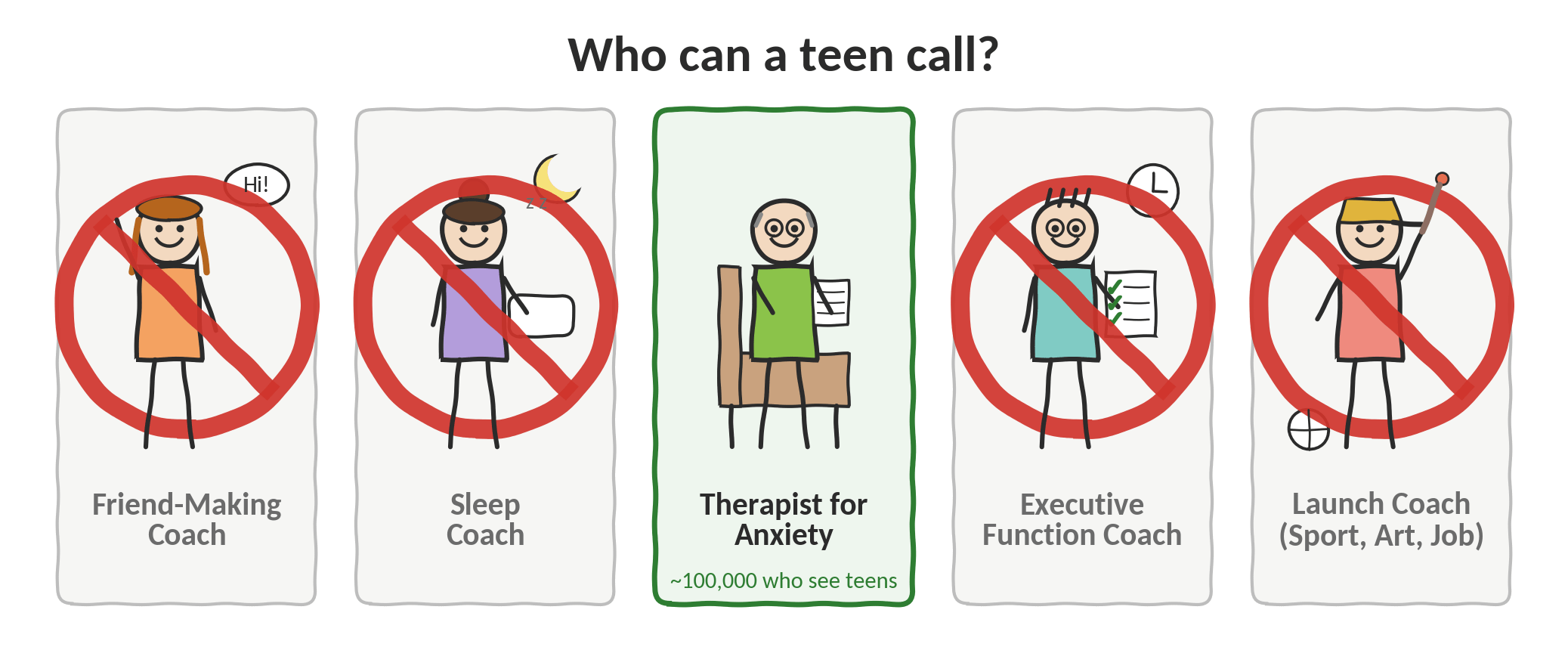
By my rough math, a teen with anxiety has about 100 times more adult help available than a teen with a sleep problem. And about 1,000 times more than a teen who is lonely.
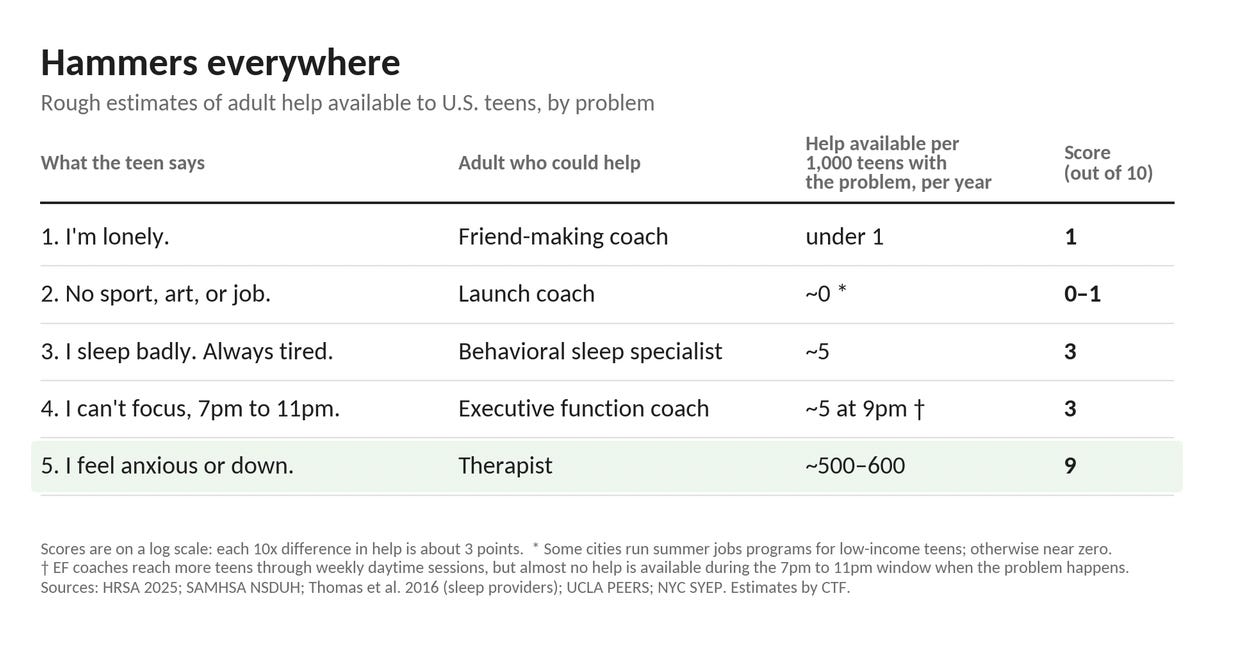
Hammers everywhere. Again, the occasional blip of pliers or saw, or the occasional blip of experts who DO these other things, just makes the point.
So a teen - and their parents - with five problems faces a practical choice. Work on the anxiety. Or get no adult help at all.
Or try to use the hammer for the other problems - ie, talk to your therapist about sleep, loneliness, can’t get off the couch, etc. Do they sometimes help there? Sure. But that’s pliers work done by someone trained on hammers.
This seems like a CRAZY Big Picture situation to me.
I think THIS is the key limiting factor to teen mental health.
People, if we don’t want to push so many people into therapy who won’t really benefit, we need some other solution to say to parents, who’ve already TRIED to “just leave it alone,” or already TRIED to help kiddo, and things still seem…bleak. It’s so asymmetric! Of course we have over-consumption of therapy for teens, we offer hammers or NOTHING (no adult help).
It should be Teen picks any Reasonable Problem to work on, that alone massively increases the chance of success; and can then enlist an adult helper.
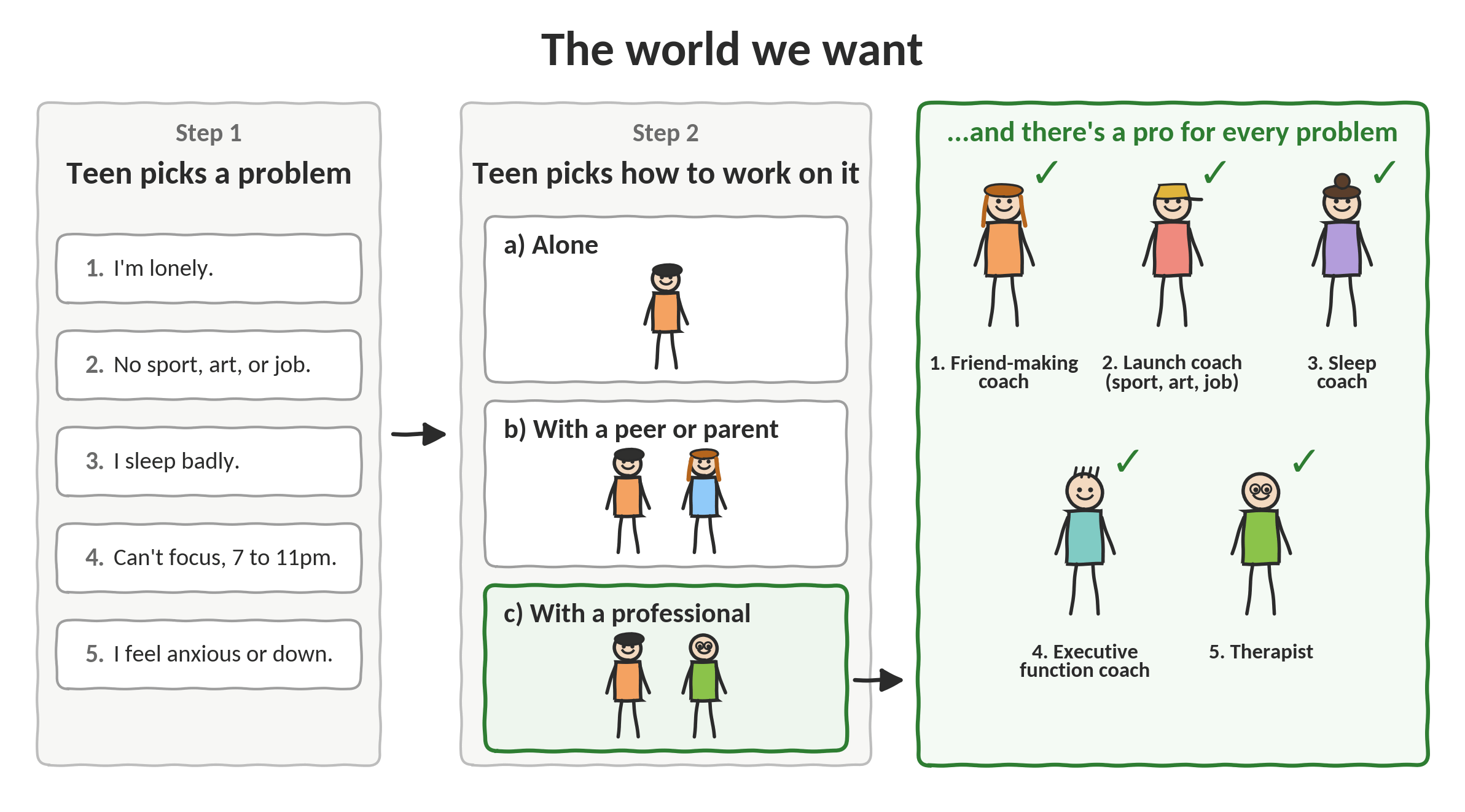
Do I have this right, or nah?
We need to massively ratchet up CHOICE/AGENCY of teens to first choose the problem they feel like working on - the doorbell, back deck, or tree trimming.
Doing that will decrease demand for therapy, and displace with demand for adult coaches to solve OTHER problems.
Whether that’s cash neutral, let’s leave for another time. I.e., how much is substitution away from therapy, versus new demand for services.
Everyone wins with dramatic expansion of Teen Choice/Agency:
Therapists now end up with teen clients way more likely to actually WANT therapy.
Parent has a reasonable list of adult helpers, doesn’t feel their parenting choice is therapy or just leave teen to himself.
Society ends up with less total therapy hours; more productive pro-social teen behaviors; and most of all, better mental health. I.e., net anxiety goes down, net depression goes down, because of the positive spillovers of more friendship, more sports, more sleep, etc.